You’re sitting at the kitchen table with a stack of printouts, trying to figure out which nursing home is actually safe for your mom. A friend mentioned something about “five-star ratings,” so you pulled them up on Medicare’s website. One facility near you shows four stars. Another shows three. But what does that actually mean? Is a three-star nursing home dangerous? Is a four-star one truly excellent? Before you make one of the most important decisions your family will ever face, it’s worth understanding what those stars are really measuring — and, just as importantly, what they’re not.
What the CMS 5-Star Rating System Actually Is
The Centers for Medicare and Medicaid Services — CMS for short — runs a public rating system that assigns every Medicare- and Medicaid-certified nursing home in the country a score from one to five stars. Think of it like a report card that the federal government publishes so families like yours can compare facilities side by side. The program is called the Nursing Home Care Compare system, and it covers more than 114,000 care providers across the United States.
CMS doesn’t pull these ratings out of thin air. They’re built from three separate data sources, each one carrying its own weight in the final score. The first is health inspections, which are unannounced visits from state surveyors who walk through the facility and look for anything that falls below federal standards. The second is staffing levels, which measures how many registered nurses, licensed practical nurses, and certified nursing assistants are on the floor relative to the number of residents. The third is quality measures, which tracks clinical outcomes like the percentage of residents who had pressure ulcers, experienced falls, or were given antipsychotic medications.
Each of these three areas gets its own star rating, and then CMS combines them into a single overall score. That overall number is what most families see first — and unfortunately, it’s where a lot of misunderstanding begins.
What the Numbers Actually Mean
Here’s the first thing that might surprise you: the average nursing home in the United States currently holds exactly 3.0 stars. That’s not a coincidence or a statistical quirk — CMS deliberately designs the system so that roughly the middle of the pack lands around three stars. A three-star facility isn’t a failing facility. It’s an average one. A five-star rating means the facility performed well above average across the measured categories. A one-star rating is a genuine signal of concern.
Right now, 5,898 facilities carry a low star rating — meaning they fall into the one- or two-star range. That’s a meaningful number of places where families may be placing loved ones without realizing the documented gaps in care. At the same time, 6,563 facilities have been fined by regulators at some point, which is a separate but related data point worth understanding.
The health inspection component tends to carry the most weight in dragging down an overall score, and for good reason. When surveyors find deficiencies — things like medication errors, inadequate wound care, or unsafe food handling — those citations get logged and affect the rating for a rolling three-year window. A facility that had serious problems three years ago but has dramatically improved may still carry a lower score today. Conversely, a facility that learned to prepare very well for inspection cycles might look better on paper than it performs day-to-day.
The staffing component is increasingly data-driven. CMS now pulls from Payroll-Based Journal records, which means facilities actually have to report real payroll data rather than self-reported staffing numbers. This closed a major loophole that existed for years. Still, staffing ratings don’t capture things like staff turnover, which can be a more telling indicator of workplace culture and care consistency than raw headcount numbers.
Quality measures cover real clinical outcomes, but they’re based on what facilities report about their own residents. While audits exist, there’s still an inherent tension in any self-reported data system.
How to Find a Nursing Home’s Rating Yourself
You don’t need to pay anyone or sign up for anything to see these ratings. Here’s exactly how to do it in a few minutes.
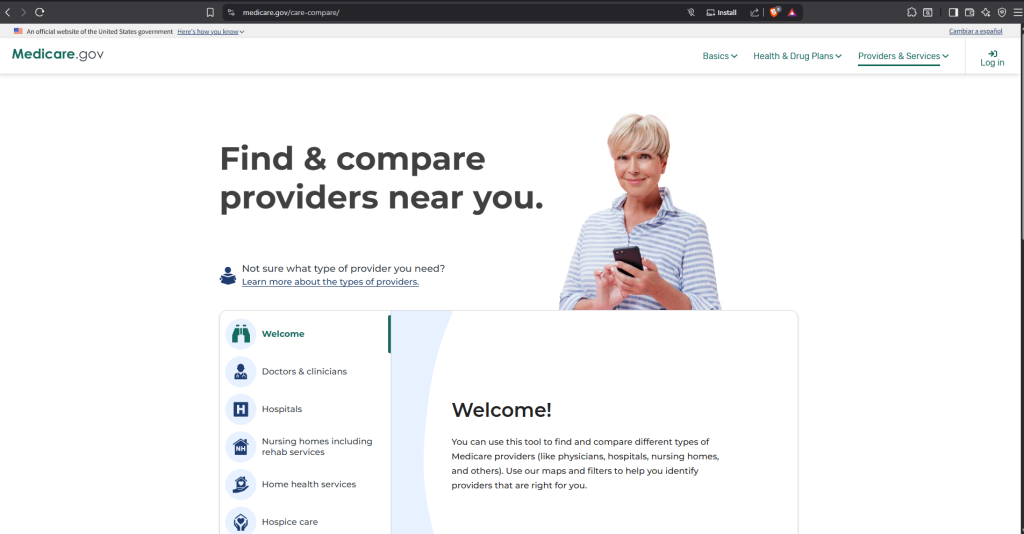
Step one: Open your browser and go to medicare.gov/care-compare. You’ll land on a clean search page.
Step two: Under “Find care near you,” select Nursing Homes from the care type options.
Step three: Type in the city, state, or ZIP code where you’re searching. A list of nearby facilities will appear, each showing an overall star rating.
Step four: Click on any facility’s name to open its full profile. Don’t just look at the overall number. Scroll down and look at the three separate component ratings — health inspections, staffing, and quality measures. A facility can have an overall rating of three stars while carrying a one-star health inspection score, which tells a very different story than three stars evenly distributed across categories.
Step five: Still on that profile page, scroll to the health inspection details section. You can read the actual findings from the most recent surveys, including what deficiencies were cited and whether they involved actual harm to residents.
Step six: Note the date of the most recent inspection. Ratings based on older inspections may not reflect current conditions, especially if there’s been significant staff or management turnover.
What to Do If You Find Red Flags
Finding a one-star health inspection rating or a history of fines doesn’t automatically mean you should cross a facility off your list — but it absolutely means you should dig deeper before making a decision.
Start by calling the facility directly and asking what specific steps they’ve taken to address any cited deficiencies. A well-run facility with a transparent management team will be able to answer this clearly and specifically. Vague reassurances are themselves a yellow flag.
Next, contact your state’s Long-Term Care Ombudsman. This is a free government resource that advocates for nursing home residents. Ombudsmen keep records of complaints that may not appear in the CMS data at all, and they can tell you whether a facility has a pattern of unresolved grievances.
Visit in person, ideally unannounced or at a time that wasn’t pre-arranged by the facility. Notice whether call lights are being answered promptly, whether residents appear engaged and cared for, and whether staff seem to know residents by name. No rating system captures the feeling in the hallways at three in the afternoon on a random Tuesday.
Also run the facility’s name through the OIG Exclusions database at oig.hhs.gov to check whether any affiliated individuals have been excluded from federal healthcare programs. Our data shows 38 caregivers currently excluded by the OIG across the national database — a small but serious number that underscores why this step matters.
The 5-Minute Check Right Now
If you have a facility in mind and five minutes right now, here’s the fastest meaningful check you can do. Go to medicare.gov/care-compare, pull up the facility, and look at exactly three things: the health inspection star rating on its own, the date of the most recent survey, and whether there are any citations involving actual harm in the inspection detail. Those three data points together will tell you far more than the overall star number alone. If all three look reasonable, you’re in decent shape to move forward with an in-person visit. If any of them raises a question, you now know exactly what to ask about when you call.
The CMS rating system is genuinely useful — it democratized information that families once had no access to at all. But it’s a starting point, not a final answer. It measures what’s measurable. It misses culture, compassion, and the hundred daily moments that define whether a place truly cares for the people who live there.
At VerifiedCare.app, we go beyond the star rating to surface the data points that actually matter to families — including inspection histories, fine records, staffing trends, and OIG exclusion flags — all in one place, without the hours of searching across government databases. If you’re evaluating nursing homes right now, start your free search at VerifiedCare.app and give your family the clearer picture they deserve.
“`